


If you have ever stood in front of a toolbox wondering which impact tool to grab, you are not alone. The difference between an impact wrench and an impact driver is a common source of confusion for DIYers, mechanics, and welders alike.
Both tools look similar. Both make loud, rapid impacts. Both are designed to make tough fastening jobs easier. But they are built for very different tasks. Using the wrong one can slow your work, damage fasteners, or even put unnecessary strain on the tool.
This guide breaks down the real differences between an impact wrench vs impact driver, explains when to use each, and helps you choose the right tool for your work.
The Core Mechanism: How Impact Tools Work
Before separating them, it is vital to understand what binds them together. Both tools rely on an internal mechanism consisting of a motor, a spring, a hammer (impactor), and an anvil (output shaft).
Unlike standard drills that rely solely on steady, constant motor torque, impact tools use concussive force. When the tool encounters resistance (like a tight screw), the internal hammer strikes the anvil rapidly, thousands of times per minute (IPM).
This generates a significant amount of rotational force without transferring the twisting torque to your wrist.
Pro Tip: The "impact" action is why you can drive a 6-inch lag bolt with one hand using an impact driver, whereas a standard drill would twist your wrist violently if the bit jammed.
What is an Impact Driver?

The impact driver is the surgeon of the impact world. It is compact, lightweight, and designed for speed and precision driving.
The Defining Feature: 1/4-Inch Hex Collet
The easiest way to identify an impact driver is the nose. Instead of a square anvil, it features a 1/4-inch hexagonal quick-release collet. This accepts hex-shank screwdriver bits exclusively. You cannot attach a socket directly to an impact driver without an adapter.
Primary Use Cases
- Driving long deck screws into lumber.
- Fastening self-tapping screws into sheet metal (common in welding fabrication).
- Cabinetry and furniture assembly.
- Drilling holes (with hex-shank drill bits) is less precise than a drill.
Read More: How to Use Impact Wrench to Remove
What is an Impact Wrench?

If the driver is a surgeon, the impact wrench is the demolition expert. Often referred to as an "impact gun" or "rattle gun," this tool sacrifices finesse for raw, earth-moving power.
The Defining Feature: Square Drive
Impact wrenches utilize a square drive anvil designed to accept impact-rated sockets directly. The most common sizes are:
- 3/8-inch: For compact automotive work.
- 1/2-inch: The industry standard for tires and suspension.
- 3/4-inch and 1-inch: For heavy machinery, structural steel, and industrial welding projects.
Primary Use Cases
- Removing rusted or over-torqued lug nuts.
- Breaking loose seized bolts on farm equipment.
- Assembling structural steel beams.
- Heavy equipment maintenance.
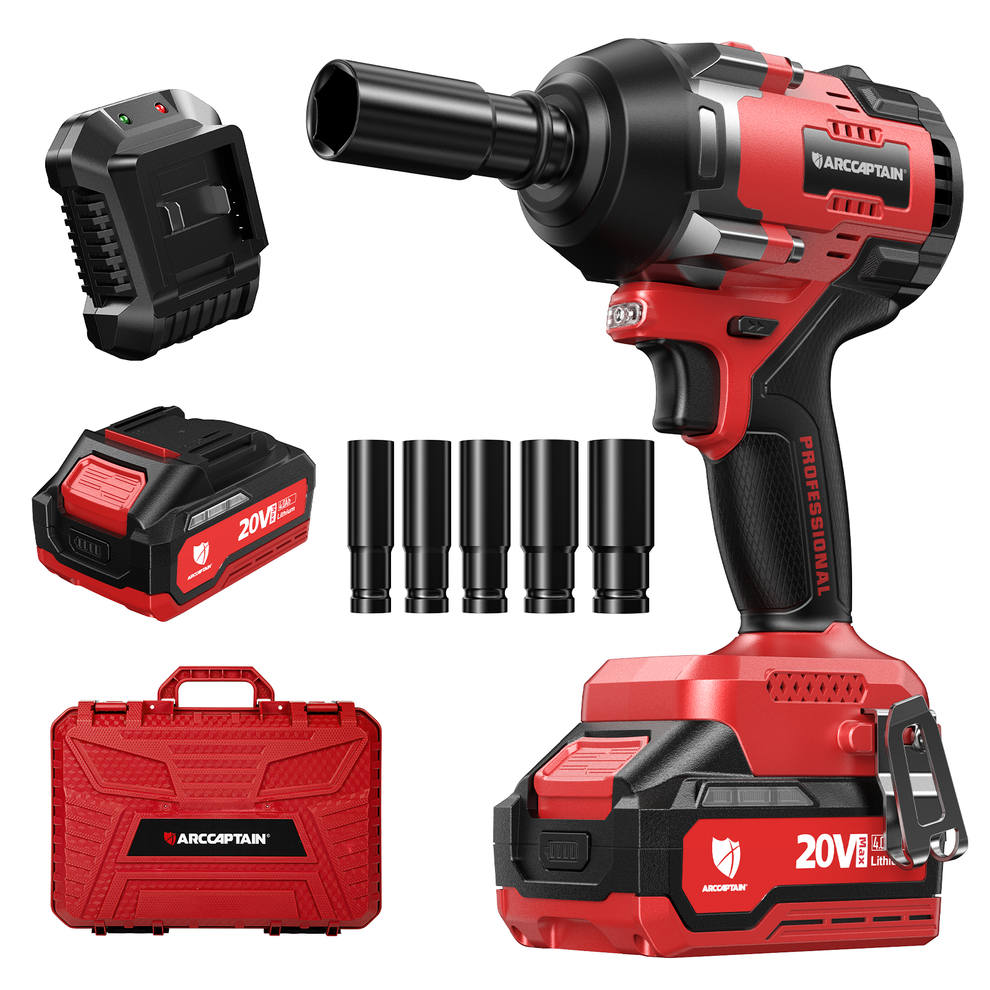
20V Brushless Cordless Impact Wrench
- Up to 885 ft-lb breakaway torque for removing stubborn or rusted bolts
- Three forward torque levels (369 / 553 / 738 ft-lb) plus powerful 885 ft-lb reverse mode
- Long-lasting 4.0Ah battery delivers 60–70 minutes of runtime and uses a Makita-style interface
- Compact 4 lb design with LED light for tight spaces and low-visibility work areas
- Auto-stop protection helps prevent overtightening and bolt damage
- 1/2-inch drive with socket set included, supports sockets up to 1.57 inches
Impact Wrench vs Impact Driver: The Technical Specs
Let us look at the numbers. While specifications vary by brand and voltage (12V vs 18V/20V), here is a general comparison of standard professional-grade tools.
|
Feature |
Impact Driver |
Impact Wrench (1/2" Mid-Torque) |
|
Drive Style |
1/4" Hex Collet |
Square Drive (1/4", 3/8", 1/2", etc.) |
|
Torque (Inch-lbs / Ft-lbs) |
1,500 - 2,200 in-lbs |
300 - 1,400+ ft-lbs |
|
RPM (Speed) |
Higher (up to 3,000+) |
Lower (usually < 2,000) |
|
Weight |
Light (2-3 lbs) |
Heavy (4-8+ lbs) |
|
Best For |
Screws, Small Lags |
Nuts, Bolts, Heavy Fasteners |
1. Torque: The Deciding Factor
Torque is rotational force. Impact drivers usually measure torque in inch-pounds. A powerful driver might hit 2,000 in-lbs (roughly 166 ft-lbs).
Impact wrenches measure torque in foot-pounds. A high-torque pneumatic or battery-powered impact wrench can easily exceed 1,000 ft-lbs of nut-busting torque. Trying to remove a rusted lug nut with an impact driver is often futile because it lacks the sheer mass behind the hammer mechanism to break the bond of the rust.
2. Adapters: Can They Switch Roles?
You can buy adapters to turn an impact driver into a wrench (Hex to Square) and vice versa. However, proceed with caution:
- Driver to Wrench: You risk snapping the adapter or the internal anvil of the driver if you attempt to loosen a bolt that requires more torque than the tool is rated for.
- Wrench to Driver: An impact wrench is generally too heavy and powerful for driving screws. You will likely snap the screw head off or overdrive it deep into the material before you can release the trigger.
Which Tool Do I Grab?
Scenario A: Changing Tires Winner: Impact Wrench. Lug nuts are typically torqued between 80 and 100 ft-lbs, but rust and heat cycles can double the force required to remove them. An impact driver usually lacks the "breakaway" torque needed here.
Scenario B: Building a Wooden Workbench Winner: Impact Driver. Driving 3-inch deck screws or construction lags into 4x4 posts is the native habitat of the driver. It is fast, efficient, and easy to control with one hand.
Scenario C: Automotive Engine Repair Winner: Both. You will want a 3/8" compact impact wrench for suspension and engine mount bolts, but an impact driver is excellent for removing undertrays, hose clamps, and smaller 10mm fasteners (with a socket adapter).
Also Read: How to Use an Impact Wrench for Fast and Easy Repairs
Safety and Maintenance Tips
Using high-torque tools requires respect for safety protocols. At Arccaptain, we prioritize safety in welding and fabrication, and tool usage is no different.
- Wear Eye Protection: Impact sockets can shatter under extreme stress, and metal shards from stripped screws can fly at high speeds.
- Use Impact-Rated Accessories: Never use chrome sockets (designed for hand ratchets) on an impact wrench. Chrome is brittle and will explode. Always use black phosphate finish "impact sockets."
- Watch Your Wrists: While impact tools reduce wrist strain compared to drills, a sudden jam on a high-torque wrench can still cause injury.
- Don't Over-Torque: When tightening, be careful. An impact wrench can stretch threads or snap studs in seconds. Use a torque wrench for final tightening on critical components like wheels.
Conclusion
To summarize the impact wrench vs impact driver debate: The driver is your go-to for construction, screws, and general fastening. The wrench is your heavy hitter for automotive work, structural steel, and removing seized nuts.
If you are building a complete workshop, you eventually need both. However, if you are strictly doing home renovations, start with the driver. If you are an aspiring mechanic, the impact wrench is essential.
Remember: The most expensive tool is the one you have to buy twice because you broke the first one using it for the wrong job. Invest in quality, use the right accessories, and work safely.
Best Selling Welders
Explore More
Frequently Asked Questions
Can I use an impact driver to remove lug nuts?
Technically, yes, if the lug nuts are not over-tightened or rusted. However, it is not the right tool for the job. You will likely strain the tool's motor and anvil. For reliable tire changes, always use a 1/2-inch impact wrench.
Do I need special bits for an impact driver?
Yes. You must use "impact-rated" bits. Standard screwdriver bits are made of harder, more brittle steel that will shatter under the concussive force of an impact driver. Impact bits are treated to be slightly more ductile to absorb the shock.
Why is my impact wrench not loosening the bolt?
Several factors could be at play: the tool may lack sufficient torque (check your air pressure if pneumatic, or battery charge if cordless), the bolt may be cross-threaded, or you may be using an extension bar, which reduces torque transfer. Try penetrating oil and heat first.
Can an impact wrench be used as a drill?
Generally, no. While adapters exist to hold drill bits, the low RPM and hammering action make for very messy, imprecise holes. It can easily snap small drill bits.

What Is the 2F Welding Position?

7018 Welding Rod Uses: Applications, Benefits, and Best Practices

What is Spray Transfer Welding? (Beginner's Guide)

