


If you are trying to decide between an impact drill vs. an impact wrench, you are asking the right question. These tools are often confused because they look similar and both deliver impact force. But they are built for very different jobs.
An impact drill is a multipurpose tool. It drills holes and drives fasteners. An impact wrench is a specialized tool designed to apply extreme torque to large fasteners. Using the wrong tool can slow your work, damage materials, or shorten tool life.
This guide explains how each tool works, when to use them, and which one fits your job best.
The Quick Takeaways
- Impact Drill (Hammer Drill): The master of drilling holes. Uses a 3-jaw chuck to hold smooth drill bits. Best for drilling into wood, metal, and masonry (concrete/brick) using an axial hammering action.
- Impact Wrench: The master of removing nuts and bolts. Uses a square drive anvil to hold sockets. Best for automotive work, heavy equipment, and structural steel applications requiring high rotational torque.
- The Verdict: If you need to make holes, get the drill. If you need to remove tires or rusted bolts, get the wrench.
What is an Impact Drill (Hammer Drill)?

An impact drill is a power drill designed to drill holes and drive fasteners more efficiently than a standard drill. It combines rotation with a forward hammering motion.
This hammering action helps the drill bit break through resistance, especially in harder materials like masonry or metal.
What an Impact Drill Is Designed to Do
Impact drills are built for versatility. They handle many everyday tasks across different trades.
Common uses include:
- Drilling holes in wood, plastic, and metal
- Drilling into concrete or brick using hammer mode
- Driving screws and fasteners
- Installing brackets, frames, and fixtures
- Light fabrication and home improvement work
An impact drill is often the first power tool professionals and homeowners buy because it can handle many jobs with one tool.
Key Parts of an Impact Drill
- Standard drill chuck that holds drill bits and driver bits
- Variable speed trigger for control
- Adjustable torque or clutch settings
- Hammer mode for masonry work
- High rotational speed
Impact drills are designed to give the user control, accuracy, and flexibility.
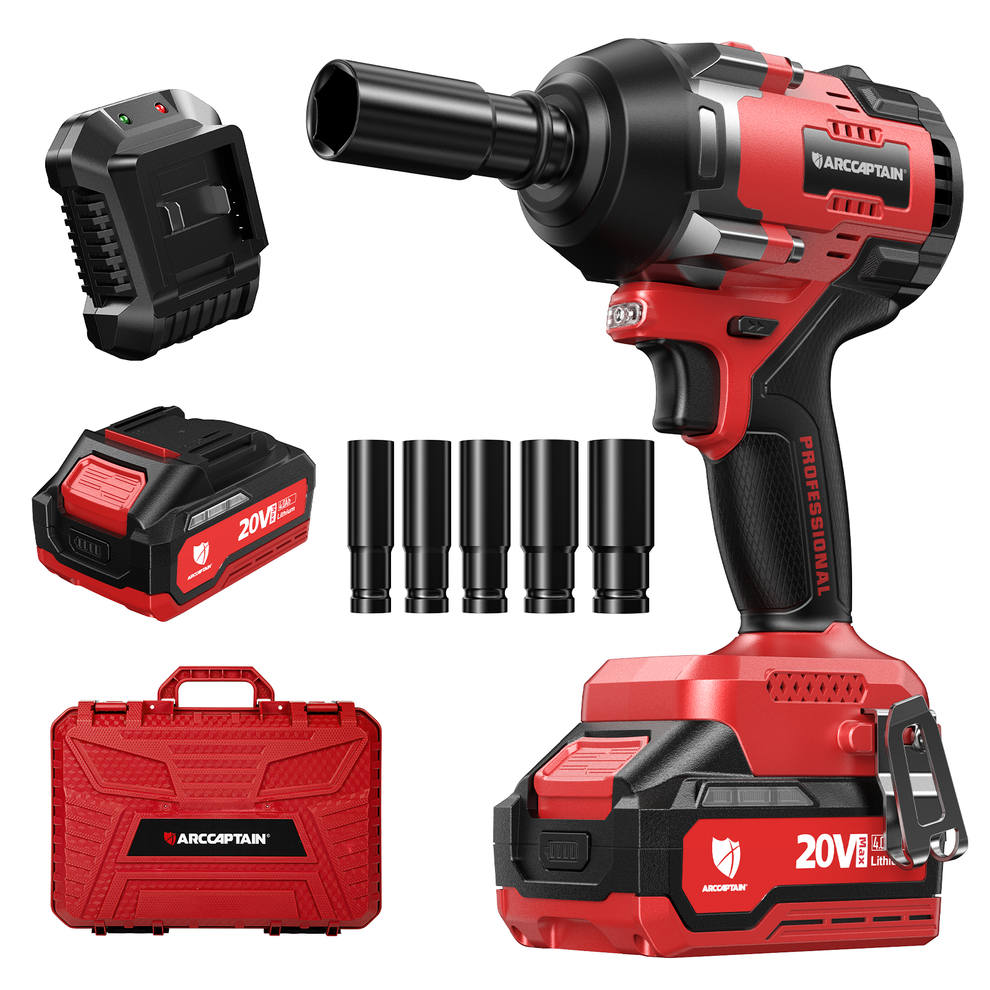
20V Brushless Cordless Impact Wrench
- Up to 885 ft-lb breakaway torque for removing stubborn or rusted bolts
- Three forward torque levels (369 / 553 / 738 ft-lb) plus powerful 885 ft-lb reverse mode
- Long-lasting 4.0Ah battery delivers 60–70 minutes of runtime and uses a Makita-style interface
- Compact 4 lb design with LED light for tight spaces and low-visibility work areas
- Auto-stop protection helps prevent overtightening and bolt damage
- 1/2-inch drive with socket set included, supports sockets up to 1.57 inches
What is an Impact Wrench?
An impact wrench is a power tool built for one purpose. Applying high torque to loosen or tighten large fasteners.
Instead of a forward hammering motion, an impact wrench delivers strong rotational impacts. These impacts allow it to break loose bolts that would be impossible to remove by hand.
What an Impact Wrench Is Designed to Do
Impact wrenches are used where strength matters more than precision.
Common uses include:
- Removing lug nuts from cars and trucks
- Looening rusted or seized bolts
- Working on suspension and frame components
- Heavy equipment maintenance
- Industrial and mechanical repair
In welding shops, impact wrenches are often used to disassemble steel structures or machinery before repairs.
Key Parts of an Impact Wrench
- Square drive, commonly 1/2 inch or 3/8 inch
- Designed for impact-rated sockets
- Extremely high torque output
- Lower rotational speed
- Strong internal hammer mechanism
Impact wrenches are not drilling tools. They are torque tools.
Read More: How to Use Impact Wrench to Remove Wheel Nuts Safely
Impact Drill vs Impact Wrench: Head-to-Head Comparison
Let's look at the specs side-by-side to visualize the difference in power and application.
|
Feature |
Impact Drill (Hammer Drill) |
Impact Wrench (1/2" Drive) |
|
Bit Holder |
3-Jaw Chuck (Adjustable) |
Square Drive Anvil (Fixed) |
|
Primary Motion |
Rotation + Axial (Punt/Push) |
Rotation + Concussive (Twist) |
|
Torque |
Low (30-80 ft-lbs) |
Very High (200-1,200+ ft-lbs) |
|
Primary Job |
Making Holes |
Loosening/Tightening Nuts |
|
Accessory Type |
Drill Bits, Hole Saws |
Impact Sockets |
|
Precision |
High (for placement) |
Low (brute force) |
Impact Drill vs Impact Wrench: How They Work Differently
Understanding how these tools work explains why they feel so different in use.
How an Impact Drill Works
An impact drill uses two types of force:
- Rotation to spin the bit
- Forward hammering to help penetrate material
When drilling into hard surfaces, the hammering motion reduces resistance. When driving screws, the tool relies mainly on rotation and torque control.
This design makes the impact drill effective and easy to control.
How an Impact Wrench Works
An impact wrench works through rotational impacts.
Inside the tool, a hammer mechanism builds energy, then releases it in short bursts. These bursts deliver extreme torque to the fastener without constant pressure from the user.
This design allows the tool to break loose bolts that would otherwise require long breaker bars or heat.
Also Read: How to Use an Impact Wrench for Fast and Easy Repairs
Which Tool Do You Need?
To truly understand the impact drill vs impact wrench debate, we need to look at real-world scenarios you might face in your shop.
Scenario 1: Mounting a Vise to Concrete
The Job: You need to drill four holes into your concrete shop floor to bolt down a grinder stand.
The Winner: Impact Drill
An impact wrench cannot hold a masonry bit. The hammering action of the impact drill will chip away at the concrete, allowing the bit to penetrate. This is the only tool for this job.
Scenario 2: Changing a Flat Tire
The Job: You have a flat on the side of the road, or you are rotating tires in the garage.
The Winner: Impact Wrench. An impact drill lacks the rotational torque to break loose lug nuts that are torqued to 100 ft-lbs or more. If you try to use a drill with a socket adapter, you risk burning out the motor or snapping the adapter. The impact wrench will zip the nuts off in seconds.
Scenario 3: Assembling a Welding Table
The Job: You are bolting together a heavy steel frame using 1/2-inch bolts and nuts.
The Winner: Impact Wrench.
While you could use a wrench and ratchet, the impact wrench will speed up the assembly process ten-fold. It ensures the bolts are tight and secure. However, be careful not to over-tighten and crush the tubing.
Can They Swap Roles?
This is a common question: Can I use my impact wrench to drill holes?
The short answer is no, not effectively. While adapters exist that convert a 1/2" square drive to a drill chuck, the impact wrench spins too slowly (RPM) and hits too hard (Torque) for drilling. You will likely snap the drill bit instantly or create a very ragged, ugly hole.
Conversely, can I use my impact drill to remove bolts? Only if they are small and not rusted. For anything larger than a 1/4" lag bolt or a standard car lug nut, the drill simply does not have the power.
Safety First: Handling High-Torque Tools
When operating these powerful tools, safety is paramount.
- Secure Your Work: When using an impact drill, if the bit binds in the metal or wood, the drill body will snap around violently. Always use the side handle and brace yourself.
- Use Impact-Rated Sockets: Never put a chrome hand-socket on an impact wrench. The force can cause the chrome to shatter, sending sharp shrapnel into your eyes. Always use black phosphate impact sockets.
- Hearing Protection: Both tools, especially when hammering against steel or concrete, generate decibels well above the hearing damage threshold.
Best Selling Welders
Explore More
Conclusion
When deciding between an impact drill vs impact wrench, the choice comes down to the verb: are you drilling or are you wrenching?
If your days are spent making holes in wood, metal, and masonry, the Impact Drill (Hammer Drill) is the versatile workhorse you need. If your time is spent wrestling with rusted bolts, changing tires, and assembling heavy steel structures, the Impact Wrench is the muscle you cannot live without. For the complete fabricator, the answer is often "both."
Ready to upgrade your arsenal? High-quality tools are the difference between a job well done and a day of frustration.
- Check Out Our Welding Tools Collection – Find the perfect clamps, magnets, and accessories.
- Tools for Welders – Essential gear for every fabrication shop.
- New Arrival Welding Machine Parts – Keep your equipment running at peak performance.
Frequently Asked Questions
What is the difference between an impact drill and a hammer drill?
In most contexts, they are the same thing. A "hammer drill" is the technical term for a drill with a percussion setting. However, some people confuse "impact drill" with "impact driver," which is a different tool used for driving screws.
Can I use an impact wrench as a drill?
It is not recommended. An impact wrench has high torque and low RPM, which is the opposite of what you need for drilling holes. Using an adapter to attach a drill bit often results in broken bits and messy holes.
Is an impact wrench better than a drill?
They are not comparable; they are complementary. An impact wrench is "better" at removing lug nuts. A drill is "better" at making holes. You cannot replace one with the other.
Do I need an impact wrench for home use?
If you do your own automotive maintenance (brakes, tires, suspension) or maintain farm equipment, yes, it is essential. For general home repairs (hanging pictures, fixing furniture), a drill or impact driver is sufficient.
What size impact wrench should I buy?
For most general automotive and fabrication tasks, a 1/2-inch mid-torque impact wrench is the "Goldilocks" tool. It is powerful enough for lug nuts but light enough to handle easily.
Can an impact drill remove lug nuts?
Generally, no. A standard impact drill (hammer drill) applies force axially (front-to-back) and lacks the rotational torque required to break loose tight lug nuts. You need an impact wrench for that task.
Related Articles:

What Is the 2F Welding Position?

7018 Welding Rod Uses: Applications, Benefits, and Best Practices

What is Spray Transfer Welding? (Beginner's Guide)

