


Stop fighting the metal. It is time to upgrade to the best cordless impact wrench for your toolkit.
Gone are the days when you needed a massive air compressor that took up half your garage, a noisy generator, and a tangled rubber hose just to get real power. Modern battery-powered impact wrenches have completely changed the game.
They now rival, and often beat, their pneumatic ancestors. They offer massive torque, total portability, and the ability to snap a rusted suspension bolt loose in seconds with a satisfying zip-zip sound.
In this guide, we will break down which specs matter. We will look at "nut-busting" torque versus fastening torque, explain why motor types matter, and help you understand battery tech so you can stop struggling and start getting work done.
Key Takeaways:
- Torque is King: You need high "breakaway torque" (nut-busting power) to remove rusted bolts. Look for at least 500+ ft-lbs for general automotive work.
- Go Brushless: Brushless motors are more efficient, run cooler, and last longer than older brushed models. They are the new standard for a reason.
- Battery Matters: A 4.0Ah battery is the sweet spot for weight and runtime. It provides enough amps for peak power while lasting about 60 to 70 minutes of heavy use.
- Drive Type: A 1/2-inch drive with a friction ring (hog ring) is the most versatile setup for cars and trucks.
- Safety Features: Look for "Auto-Stop" modes to prevent snapping bolt heads when tightening and preventing nut run-off when loosening.
- Top Pick: The Arccaptain 20V Brushless Impact Wrench delivers 885 ft-lb of torque, making it a professional-grade tool at a DIY price.
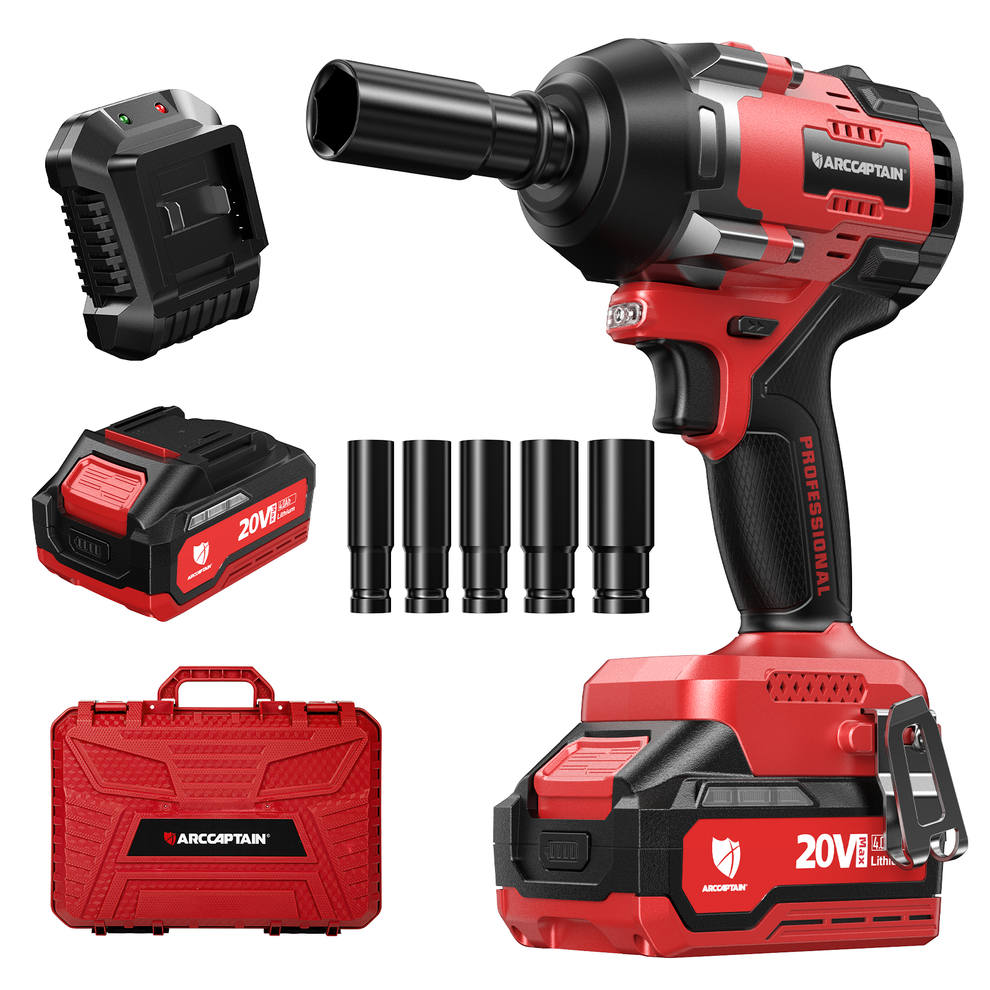
Top Pick: Arccaptain 20V Brushless Cordless Impact Wrenchh
- Up to 885 ft-lb breakaway torque for removing stubborn or rusted bolts
- Three forward torque levels (369 / 553 / 738 ft-lb) plus powerful 885 ft-lb reverse mode
- Long-lasting 4.0Ah battery delivers 60–70 minutes of runtime and uses a Makita-style interface
- Compact 4 lb design with LED light for tight spaces and low-visibility work areas
- Auto-stop protection helps prevent overtightening and bolt damage
- 1/2-inch drive with socket set included, supports sockets up to 1.57 inches
Understanding Torque: How Much Power Do You Really Need?
Torque is the rotational force that twists the nut. In the world of impact wrenches, it is the single most important spec. It is the tool's muscle. But manufacturers throw a lot of numbers around on the box, so let us clarify what they actually mean.
Breakaway Torque vs. Fastening Torque
You will often see two different numbers listed for the same tool. It is critical to know the difference.
- Fastening Torque: This is how much force the tool uses to tighten a bolt. While this number is important, you rarely want to use the full fastening power of a big impact wrench because you might strip the threads or snap the bolt head off.
- Breakaway (Nut-Busting) Torque: This is the hero stat. This is how much force the tool has to loosen a bolt.
For automotive work, breakaway torque is what matters most. Why? because removing a bolt is always harder than installing it.
Rust, corrosion, heat cycles, and road grime can seize a bolt, making it require three or four times more force to remove than it took to install. A lug nut might be torqued to 100 ft-lbs, but after a winter of salted roads, it might take 400 ft-lbs to break it loose.
Ideally, you want a tool that punches above its weight class. You want headroom. For example, the Arccaptain 20V Brushless Cordless Impact Wrench boasts an impressive 885 ft-lb of breakaway torque.
That is enough to handle axle nuts, suspension components, crank bolts, and even lug nuts on heavy-duty pickup trucks.
👉 If you are specifically looking for a tool dedicated to tires, you can dive deeper into the requirements in our guide on the Best Impact Wrench for Lug Nuts.
Adjustable Torque Settings
Power is great, but control is better. If you use full power on a small 10mm bolt holding a fender liner, you will snap the head right off instantly.
The best cordless impact wrenches have variable speed triggers or selectable modes (Low, Medium, High). This allows you to dial back the power for delicate work.
- Low Mode: Perfect for small fasteners, engine bay work, or interior bolts.
- Medium Mode: Good for brake caliper bolts or lawn mower blades.
- High Mode: Reserved for the heavy stuff like lug nuts, axle nuts, and suspension bolts.
Motor Technology: Brushed vs. Brushless
If you are shopping for a tool today, you will see the term "Brushless" plastered everywhere. Is it just marketing hype? No. It is a genuine upgrade that changes how the tool performs.
The Old Way (Brushed Motors)
Older power tools used carbon brushes to transfer electricity to the spinning rotor. These were small blocks of carbon that physically touched the spinning part of the motor.
- The Problem: Friction. Those brushes physically rub against the motor, creating heat and sparks. This friction wastes battery energy as heat instead of turning it into torque. Eventually, the brushes wear down and the tool dies or requires maintenance to replace them.
The New Standard (Brushless Motors)
Brushless motors use magnets and complex electronics to spin the rotor. There is no physical contact inside the motor. The tool's computer tells the magnets when to push and pull.
- Efficiency: Because there is no friction from brushes, the battery lasts significantly longer (often 50% longer runtime).
- Power: They run cooler, allowing the tool to deliver more consistent torque without overheating during a tough job.
- Longevity: No brushes to replace means a longer tool life. You do not have to worry about the motor burning out as easily.
- Compact Size: Brushless motors are often smaller and lighter, allowing for a more compact tool design.
👉 If you want to understand the mechanics of how these internal hammers work, check out our article: What is an Impact Wrench?.
Battery Platform and Runtime
A powerful tool is useless if the battery dies after removing three wheels. The battery is the gas tank of your cordless tool, and size matters.
Voltage (18V vs 20V)
For automotive impact wrenches, 18V and 20V are the industry standard. They offer the best balance of power and weight.
- Note: You might see "20V Max" and "18V" on different brands. In reality, they are often the exact same battery cells. 20V is the voltage right off the charger (peak), and 18V is the nominal voltage during use. Don't get too hung up on this small difference. Both platforms provide plenty of power.
Amp Hours (Ah): The Capacity
The "Ah" rating tells you how much fuel is in the tank. But it also affects power output. Think of it like a hose: a bigger hose allows more water to flow at once. A bigger battery allows more amps to flow to the motor when it encounters resistance.
- 2.0Ah: These are slim and light, but they are generally too small for a high-torque impact wrench. They will drain quickly and might not provide enough peak amperage to break a really stuck bolt. Save these for your drill.
- 4.0Ah - 5.0Ah: This is the sweet spot. They provide excellent runtime and high peak power without making the tool too heavy.
- 6.0Ah+: These offer massive runtime but can make the tool heavy, unbalanced, and hard to fit into tight spaces.
We recommend a 4.0Ah battery for most mechanics. It delivers enough amperage to hit that peak torque while giving you about 60 to 70 minutes of continuous heavy use. The Arccaptain 20V comes with a 4.0Ah battery included, and crucially, it uses a widely compatible Makita-style interface. This means if you already have batteries with that interface, you can swap them easily.
Ergonomics and Size
You are going to be holding this thing all day. Whether you are changing winter tires for the whole family or dropping a transmission, weight matters.
An old-school air impact wrench might weigh 8 pounds, plus the weight of the hose dragging behind you. The Arccaptain 20V Cordless Impact weighs just 4 lbs. This reduction in weight saves your wrists from fatigue, especially when you are working overhead or at awkward angles under a dashboard.
Handle Grip and Balance
Look for a tool with a rubberized over-mold (often called TPR) on the handle. This does two things:
- Vibration Dampening: Impact wrenches vibrate violently. The rubber absorbs some of that shock so your hands don't tingle after the job.
- Grip: Oil and grease are part of the job. A textured rubber grip ensures you don't drop the tool on your face when you are under the car.
Lighting the Way
Have you ever tried to find a bolt inside a wheel well at night or deep in an engine bay? It is a nightmare. You end up holding a flashlight in your mouth. Look for a tool with a built-in LED light. It should illuminate the work area automatically when you pull the trigger and stay on for a few seconds after you let go.
Drive Size: Why 1/2-Inch Rules
For general automotive repair (passenger cars, trucks, SUVs), a 1/2-inch drive is the gold standard.
- 3/8-inch: Good for small engine work, water pumps, and valve covers. Usually has less torque.
- 1/2-inch: The universal standard for lug nuts, suspension, and chassis work. It supports the widest range of impact sockets.
- 3/4-inch: Overkill for cars. Used for semi-trucks and heavy tractors.
Confusion Alert: Do not confuse this with a 1/4-inch hex drive. That is an impact driver, used to drive deck screws into wood, not to remove lug nuts.
👉 Read the full comparison here: Impact Wrench vs Impact Driver.
Drill vs Wrench: Similarly, don't try to use a hammer drill for bolts. See why in our breakdown of Impact Drill vs Impact Wrench.
Friction Ring vs. Detent Pin
This is a small detail that drives mechanics crazy if they pick the wrong one. The "anvil" is the square part where you attach the socket. There are two main ways the socket is held on:
-
Friction Ring (Hog Ring): This is a small C-shaped ring on the nose of the anvil.
- Pros: You can push sockets on and pull them off easily by hand.
- Best For: Mechanics who switch socket sizes frequently (going from a 19mm lug nut to a 17mm caliper bolt).
- The Arccaptain Choice: Most modern automotive impacts, including the Arccaptain 20V, use this style because it is faster.
-
Detent Pin: This is a spring-loaded pin that clicks into the hole on the socket.
- Pros: The socket is locked on tight and will not fall off, even if you drop the tool from a ladder.
- Cons: It is very hard to get the socket off. You often need a small screwdriver or a nail to poke the pin in to release the socket.
- Best For: High-altitude work where dropping a socket could kill someone.
Essential Safety Features
Modern tools are smart. They include features that protect both you and the car.
Auto-Stop Mode (The Bolt Saver)
This is a game-changer.
- Loosening: When you are loosening a bolt, the tool applies full power. As soon as the tool senses the nut has broken free and is spinning loosely, it automatically stops. This prevents the nut from spinning off the threads at 2000 RPM and flying across the shop or getting lost in the grass.
- Tightening: When tightening, the tool can sense when the bolt head hits the surface. It stops impacting almost immediately. This prevents you from overtightening a lug nut, stretching the stud, or stripping the threads.
Pro Tip: Even with auto-stop, never use an impact gun to do the final tightening on lug nuts. Always use a hand torque wrench to set them to the manufacturer's specification.
An impact wrench is for speed; a torque wrench is for safety. You can learn proper technique in our guide on How to Use an Impact Wrench.
Conclusion
Choosing the best cordless impact wrench isn't just about buying the most expensive tool on the shelf. It is about finding the right balance of torque, battery life, and durability for your needs.
You need a tool that works as hard as you do. You need a brushless motor for longevity, a 4.0Ah battery to get you through the day, and enough breakaway torque (500+ ft-lbs) to handle whatever the road throws at your vehicle. Whether you are a weekend warrior rotating tires or a serious mechanic stripping an engine block, the right tool turns a four-hour nightmare into a twenty-minute job.
Don't let a stuck bolt slow down your project. Equip yourself with the right power and get the job done faster.
Ready to Upgrade Your Shop Tools?
Stop struggling with breaker bars. Get the power you need today.
- Shop the full Cordless Impact Wrench Collection.
- Find the perfect Cordless Impact Wrench for Tires.
- Browse our heavy-duty Cordless Impact Wrench Gun options.
- See all Battery Powered Impact Wrenches.
FAQs About the Best Cordless Impact Wrench
Can a cordless impact wrench remove lug nuts?
Yes, easily. A standard car lug nut is torqued to about 80 to 100 ft-lbs. A cordless impact wrench like the Arccaptain (with 885 ft-lbs of breakaway torque) will remove them instantly, even if they are rusted, overtightened by a careless shop, or frozen by cold weather.
Is an impact wrench the same as an impact drill?
No. An impact drill (or impact driver) is designed for driving screws into wood or metal. It has a 1/4" hex chuck that accepts screwdriver bits. An impact wrench has a square drive (usually 1/2") and is designed for heavy-duty nuts and bolts. Using an impact driver on lug nuts will likely break the adapter or the tool itself.
Do I really need a brushless motor?
We highly recommend it. While brushed motors are cheaper upfront, brushless motors offer more power, longer runtime, and a longer lifespan. It is an investment that pays off quickly because you won't be buying replacement batteries or tools as often.
Can I use chrome sockets with my impact wrench?
NO. Never use chrome (hand tool) sockets on an impact wrench. Chrome sockets are made of hard, brittle steel. Under the violent hammering of an impact wrench, they can shatter or explode, sending sharp metal shrapnel into your eyes or face. Always use black phosphate "impact-rated" sockets. They are made of a softer, more ductile steel that absorbs the impact without shattering.

What Is the 2F Welding Position?

7018 Welding Rod Uses: Applications, Benefits, and Best Practices

What is Spray Transfer Welding? (Beginner's Guide)

